Tokyo Station
Bullet TrainTokyo Station is both a crowded public thoroughfare and a point of departure into the converging crises aboard the Hayate. Yuichi Kimura arrives carrying a concealed handgun and the anger that has brought him onto the train; Nanao waits on a platform as the Morioka-bound Hayate–Komachi approaches. The station’s crowds and routines make it a place where private intentions pass through a seemingly orderly public world, before the train carries its passengers into danger.
Setting and Transit Function
Tokyo Station is presented first through the sheer pressure of its crowds. Kimura has not been there for some time and cannot tell whether it is always so busy; the streams of people remind him of penguins packed tightly together. He moves through the press of travelers, cuts between souvenir shops and kiosks, climbs a short flight of stairs, and passes through the automated gate toward the Shinkansen. The scene makes the station a sequence of thresholds: public concourse, ticket gate, and platform, each carrying Kimura closer to the train and to the purpose of his journey.
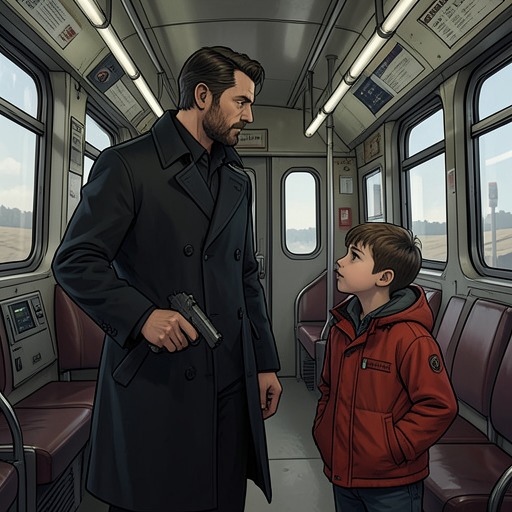
The station’s machinery and personnel do not interrupt that movement. Kimura briefly tenses as he passes the ticket gate, imagining that it might detect the handgun in his coat and bring security down on him. Nothing happens. A uniformed police officer stands near the platform, but appears not to notice him. The contrast between the weapon Kimura carries and the ordinary, untroubled operation of the station gives the setting a quiet tension: danger is present, yet the public systems around it continue to function without revealing it.
Kimura’s Arrival
For Kimura, the crowd sharpens the absence of Wataru rather than distracting him from it. A child with a backpack brushes past, apparently eight or nine years old, and Kimura thinks of his six-year-old son lying unconscious and unresponsive in a hospital bed. He recalls his mother’s grief at seeing Wataru and her fear that the boy might be able to hear what the family says. The passing child thus turns an anonymous station encounter into a painful reminder of the family crisis that has brought Kimura here.
That grief hardens into rage as Kimura thinks of the person who pushed Wataru from the roof of a department store and remains free. At the foot of the escalator, he clutches a paper bag and focuses on his own physical steadiness: he has stopped drinking, can walk straight, and believes his hands are steady. His passage through Tokyo Station is therefore not merely a change of location. It marks his deliberate movement toward a violent reckoning, while the ordinary act of boarding a train carries the weight of his attempt to answer an injury to his son.
Nanao and the Train’s Arrival
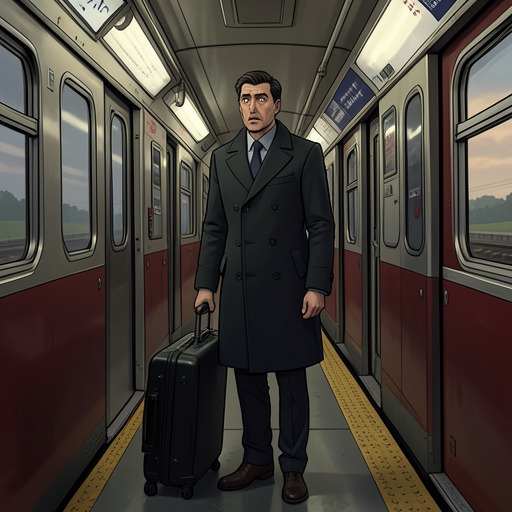
Nanao’s station scene places him amid a different kind of pressure. He waits on the platform while speaking by phone with Maria. A loudspeaker announces that the Morioka-bound Hayate–Komachi will arrive shortly on track 20; the announcement reverberates across the platform and makes it difficult for him to hear her. Their call continues briefly as the train approaches, but the immediate demands of the platform take over: Nanao tells Maria that the train is coming and ends the call after it stops.
The train’s arrival briefly overturns the platform’s orderly arrangement. Passengers stream out, filling the spaces around them, while people waiting to board lose their lines as travelers pour down the stairs. Once the flow has passed, those remaining form orderly lines again without a signal, conversation, or apparent coordination. Nanao notices that he follows the same routine. The moment makes the station’s crowd more than background: its passengers collectively enact a pattern that no one seems to direct, even as each person becomes part of it.
Boarding is delayed while the doors remain closed, apparently to allow cleaning staff to inspect the train. During this pause Nanao notices a woman in a sleeveless green dress and a short, bearded man holding a paper bag. The details place other travelers close to him in the station’s temporary waiting space, where strangers share a platform without yet knowing how their journeys may intersect. The scene then passes from the open platform into the enclosed train, where the station’s delay and bustle give way to the journey itself.
Departure and Narrative Significance
Tokyo Station remains important after the train has left it. Soon after departure, Maria receives information that the suitcase is in the storage area between cars three and four. Nanao later reasons that whoever supplied this information may still be aboard and may therefore be on his side in the attempt to steal the bag. The station is thus the point of departure for a pursuit whose essential object is already moving through the train, beyond the reach of the platform’s routines.
The station also connects the passengers’ different kinds of uncertainty. Kimura passes its gate with a gun that goes undetected; Nanao watches the crowds disorganize and re-form while waiting for a train that will carry him into a complicated theft. In both scenes, movement through a familiar transport system offers no assurance of safety or control. Tokyo Station’s practical order—gates, announcements, lines, and scheduled departure—provides the surface beneath which private grief and concealed schemes are already in motion.